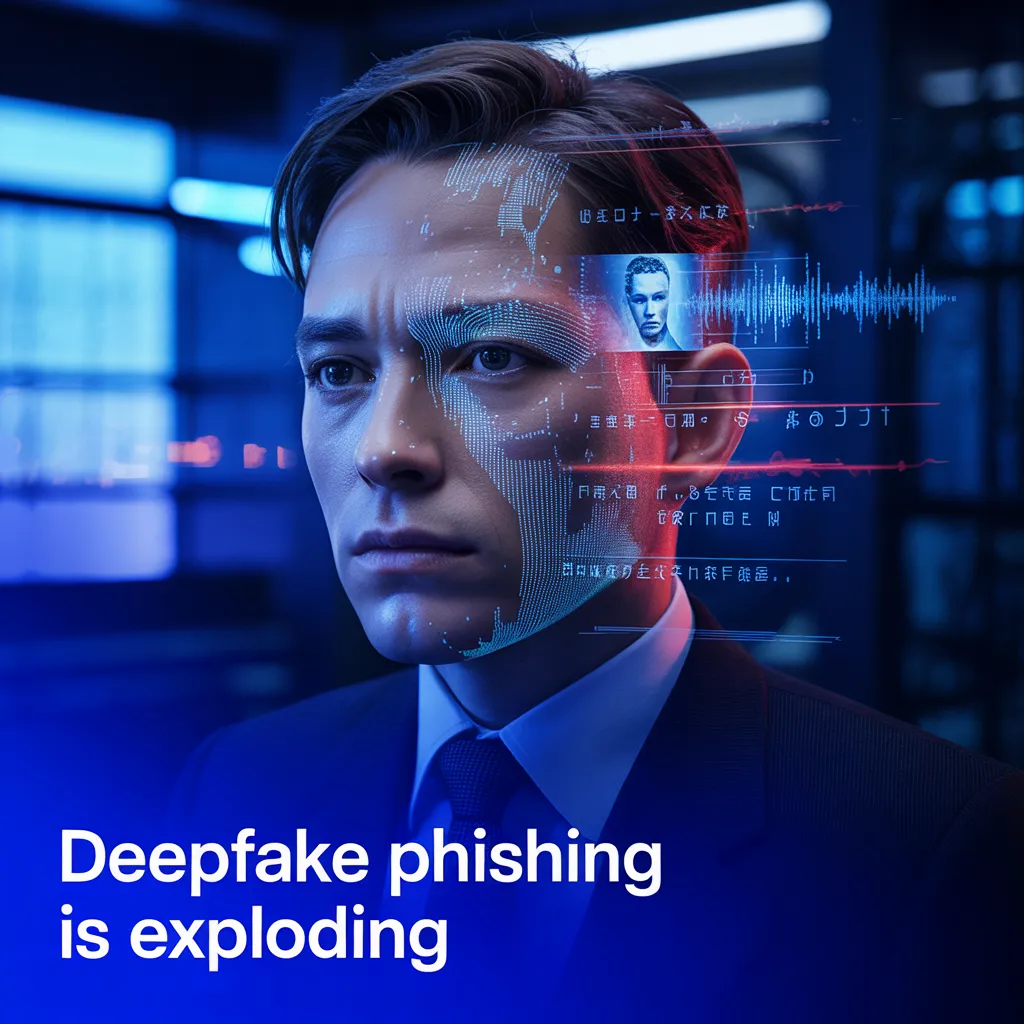
Deepfake Phishing Is Exploding
🚨 Deepfake Phishing Is Exploding: Why Traditional Security Fails in 2026
The Cyber Threat Nobody Is Ready For
Email phishing isn’t new.
What is new — and terrifyingly effective — is deepfake-powered phishing, and it’s becoming the most successful attack method heading into 2026.
This isn’t a badly written email from a fake prince anymore.
Attackers are now using AI to:
Clone executive voices
Mimic writing styles perfectly
Generate real-time video deepfakes
Reference internal projects accurately
Impersonate vendors, partners, and leadership
And professional firms are being hit hardest.
Why Deepfake Phishing Works So Well
Deepfake phishing succeeds because it attacks trust, not technology.
Attackers exploit:
Familiar voices
Real names
Accurate context
Legitimate business pressure
Human urgency (“Do this now”)
Common 2026 scenarios:
A “partner” requests an urgent wire transfer via voice message
A “CEO” asks IT to reset credentials during a meeting
A “vendor” sends a video request for updated payment info
A “client” approves document access using a cloned email style
By the time someone questions it — the damage is already done.
Why Traditional Security Tools Are Failing
Firewalls don’t detect fake voices.
Spam filters don’t stop video impersonation.
Antivirus can’t flag emotional manipulation.
Deepfake phishing bypasses:
Email security
MFA fatigue defenses
Endpoint protection
Legacy awareness training
Because the attack doesn’t look suspicious.
It looks real.
Professional Firms Are Prime Targets
Law firms, CPAs, healthcare providers, architects, and finance firms share three traits attackers love:
1️⃣ High-value data
2️⃣ Trusted relationships
3️⃣ Fast-moving decisions
Attackers don’t need to breach your systems if they can trick someone with authority into opening the door.
The New Defense Model: AI vs AI
Stopping deepfake phishing requires AI-driven cybersecurity.
Modern defenses use AI to:
Analyze voice and video anomalies
Detect behavioral inconsistencies
Flag unusual access patterns
Identify message timing irregularities
Correlate identity signals across systems
This isn’t about blocking messages.
It’s about detecting deception.
Identity Security Is the Front Line
In 2026, cybersecurity is no longer about devices — it’s about identity verification under pressure.
Your defense must include:
Phishing-resistant MFA
AI-driven identity monitoring
Just-in-time access
Role-based permissions
Real-time alerting on abnormal requests
Verification workflows for financial or data actions
If identity fails, everything fails.
Why Training Alone Is Not Enough
You can train staff forever — but AI-generated attacks evolve faster than humans.
Training must be paired with:
Automated verification
Policy-based approval workflows
AI monitoring
Clear escalation paths
Security-first culture
People are the last line of defense — not the first.
How Elliptic Systems Helps Firms Stay Ahead
Elliptic Systems protects firms against next-gen social engineering by combining:
AI-driven threat detection
Identity & access security
Behavioral analytics
Zero-trust architecture
Incident response planning
Executive-level risk assessments
We don’t just stop malware.
We stop manipulation.
The Bottom Line for January 2026
Deepfake phishing will be one of the top breach causes in 2026.
Firms that rely on “common sense” and outdated tools will be compromised.
Firms that adopt AI-driven cybersecurity will stay ahead.
The threat is evolving.
Your defense must evolve faster.
🔐 Protect Your Firm Before Trust Is Weaponized
If your firm hasn’t prepared for deepfake-driven attacks, now is the time.
Let’s turn curiosity into capability without creating risk.
👉 Start your AI consulting conversation today
👉 Join us for a FREE AI Masterclass and gain Insite on the AI era, how to secure it, properly use it and leverage it with your team. Visit: https://secureaiacademy.com/webinar


