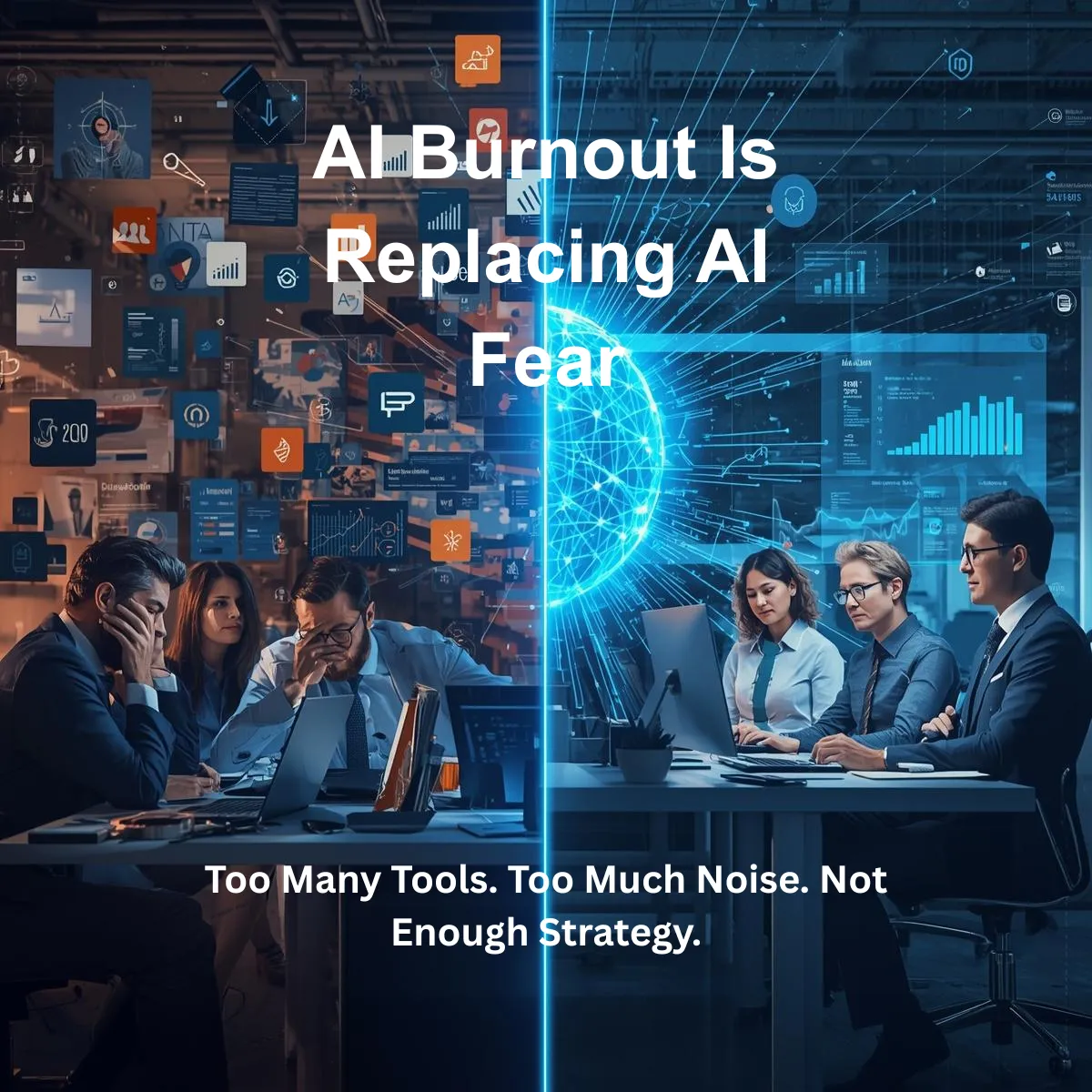
🧠 AI Burnout Is Replacing AI Fear: The New Challenge Nobody Expected
🧠 AI Burnout Is Replacing AI Fear: The New Challenge Nobody Expected
The AI Problem Has Changed
Just a few years ago, the biggest obstacle to Artificial Intelligence adoption was fear.
Business leaders worried AI would replace jobs.
Employees feared becoming obsolete.
Organizations questioned whether AI was safe, trustworthy, or even useful.
Fast forward to today, and the conversation has changed dramatically.
🤖 AI is no longer something businesses are afraid of.
Instead, many organizations are facing a completely different challenge:
AI Burnout.
Employees are overwhelmed.
Leaders are frustrated.
Teams are drowning in AI tools, constant updates, endless recommendations, and conflicting advice.
The question is no longer:
"Should we use AI?"
The question has become:
"How do we keep up without burning everyone out?"
As AI adoption accelerates across every industry, organizations that learn how to simplify AI will gain a significant advantage over those constantly chasing the next shiny tool.
😵 What Is AI Burnout?
AI burnout occurs when individuals or organizations become mentally exhausted by the constant pressure to learn, adopt, evaluate, and implement new AI technologies.
Unlike traditional technology fatigue, AI evolves at an unprecedented pace.
Every week seems to bring:
⚡ A new AI platform
⚡ A new AI feature
⚡ A new AI model
⚡ A new AI workflow
⚡ A new "must-have" tool
For many professionals, the flood of information has become overwhelming.
Instead of excitement, they feel exhausted.
Instead of innovation, they feel pressure.
Instead of confidence, they feel uncertainty.
Ironically, organizations that once struggled with AI skepticism are now struggling with AI overload.
📈 Why AI Fear Is Being Replaced by AI Fatigue
The early days of AI adoption were dominated by fear of the unknown.
Today, most business leaders recognize that AI is here to stay.
The problem is no longer acceptance.
The problem is saturation.
Employees hear about AI constantly:
📱 Social media
📰 News articles
🎤 Conferences
💻 Webinars
📧 Vendor emails
🎯 Marketing campaigns
Everyone claims their AI solution is revolutionary.
Everyone promises productivity gains.
Everyone says businesses must act immediately.
Eventually, people tune out.
When every message feels urgent, nothing feels urgent.
This creates AI fatigue—a state where employees become disengaged from AI initiatives because they simply can't process any more information.
🚨 Why Employees Disengage From AI Initiatives
Many organizations mistakenly assume resistance to AI means employees dislike technology.
In reality, burnout is often the bigger issue.
Employees disengage when:
🔄 Too Many Tools Are Introduced
One department uses ChatGPT.
Another uses Copilot.
Another uses Gemini.
Another tests three different AI platforms.
Without a clear strategy, employees become confused rather than empowered.
📚 Training Never Ends
Every week introduces new updates, features, and capabilities.
Employees begin feeling like they can never catch up.
This creates frustration and eventually disengagement.
🎯 Expectations Become Unrealistic
Some organizations expect immediate transformation after implementing AI.
When results don't appear overnight, both leadership and employees become discouraged.
AI is powerful, but sustainable success requires time, strategy, and refinement.
⚡ Constant Change Creates Fatigue
Human beings thrive on consistency.
AI thrives on innovation.
Balancing those realities is one of the greatest leadership challenges organizations face today.
💡 The Solution: Simplify AI Adoption
Many businesses assume the answer to AI success is adding more tools.
In reality, the opposite is often true.
The organizations seeing the best results are not necessarily using the most AI platforms.
They're using the right ones.
Successfully.
Instead of chasing every trend, focus on:
✅ Solving real business problems
✅ Improving existing workflows
✅ Reducing complexity
✅ Driving measurable outcomes
AI should make work easier—not more complicated.
🛠️ Build Sustainable AI Workflows
One of the most common mistakes organizations make is implementing AI without integrating it into everyday operations.
AI becomes an experiment instead of a system.
Sustainable AI adoption starts with identifying repetitive tasks that consume time and resources.
Examples include:
📄 Document creation
📧 Email management
📊 Reporting
📅 Scheduling
📝 Meeting summaries
📋 Data analysis
Rather than introducing ten new tools, focus on improving one workflow at a time.
Small wins build confidence.
Confidence drives adoption.
Adoption drives results.
🤝 Focus on People, Not Just Technology
Technology alone does not create transformation.
People do.
Organizations often spend thousands of dollars on AI software while investing very little in employee enablement.
That's backwards.
Employees need:
🎯 Clear objectives
🎯 Practical training
🎯 Real-world use cases
🎯 Ongoing support
🎯 Leadership alignment
When people understand how AI helps them succeed, adoption accelerates naturally.
When AI feels like another burden, resistance grows.
The most successful AI programs focus on empowering employees rather than overwhelming them.
🚀 How To Create Long-Term AI Success
Long-term AI success isn't about implementing the newest tool every month.
It's about creating a sustainable strategy.
Successful organizations typically follow a few key principles:
1️⃣ Prioritize Business Outcomes
Start with business goals.
Then select AI solutions that support those goals.
Not the other way around.
2️⃣ Standardize Where Possible
Reducing tool sprawl improves efficiency, security, and adoption.
Consistency matters.
3️⃣ Measure Results
Track productivity gains, time savings, cost reductions, and process improvements.
If AI isn't creating measurable value, adjustments are needed.
4️⃣ Embrace Continuous Improvement
AI is evolving rapidly.
Your strategy should evolve too.
The key is controlled evolution—not constant chaos.
🌟 The Future Belongs to Businesses That Simplify AI
The next competitive advantage won't come from using the most AI tools.
It will come from using AI intentionally.
Organizations that simplify adoption, reduce complexity, and create sustainable workflows will outperform competitors who constantly chase the latest trend.
The companies winning with AI tomorrow won't necessarily be the ones moving fastest today.
They'll be the ones building systems that employees actually use.
Because the greatest threat is no longer fear of AI.
It's exhaustion from trying to do too much, too quickly.
The future belongs to organizations that make AI manageable, practical, and sustainable.
🤖 Ready to Build an AI Strategy That Actually Works?
Elliptic Systems helps organizations cut through the noise, identify the right AI opportunities, and implement practical solutions that drive measurable business results without overwhelming teams.
Whether you're just beginning your AI journey or struggling with AI fatigue, we can help you create a clear roadmap for long-term success.
👉 Schedule your AI Consultation today 🌐
Stop chasing every AI trend. Start building an AI strategy that delivers real results. 🚀


